
How can you reinvent 4 legs and a desktop without compromising on the user experience?
This post is about what I have learned as a Product Designer in the Office Furniture industry, where functionality is key and aesthetics can shape the identity of a company. Office furniture has to enhance the user experience making tasks as effortless as possible, and at the same time add to the overall look and feel or identity of the office company.
Imagine working to a deadline on a desk that is shallow, has now desktop power for your laptop, on a chair that is hard and no place to store (read, hide) your lunch or satchel bag other than the floor or desk-top and you are seated, facing the wall, near a high traffic area such as a watercooler/toilet/entrance and to top it off the aircon is broken. You would likely walk into your presentation and quit. Humans are sensory, tactile beings and we are sensitive to our environments. It can shape our mood and in the workplace, it can influence how we interact with colleagues or treat clients. You can see how a choice of furniture paired with space planning can manipulate behavior and influence employee satisfaction. Below I explore how an intimate knowledge of how office furniture works and is used (not the same thing) has given me an even greater insight into behavior in an office, allowing me to be a better space planner.

What does your ideal workstation look like? – Design & render by Nushke Klopper
Here are a few practical product considerations in an office environment:
- Waiting room seating has to be at an optimal height (not too low). The aim is that someone who moves with difficulty or a lady with a short skirt can easily get-up and out of a chair without needing assistance or damaging their image/ego.
- Desks need to be at an optimum height(700 – 750mm), a comfortable width (1200 – 2000) and depth (750 – 900mm). If possible a height-adjustable desk is ideal, because the user can shift from standing to sitting throughout the day improving blood flow and alertness.
- People need power. With most office workers having switched to laptops/notepads or other mobile tech devices the demand for power that is neatly incorporated into office furniture can’t be ignored.
- A task chair, at the very least, should be height adjustable to cater to the varying heights of potential users and seat shouldn’t be too deep as to cut-off blood flow at the back of the knee. Backrests, seat sliders, adjustability of armrests, lumbar support, mobility as well as stability and strength are all considerations that can enhance or degrade the user comfort and impact their health over time.
- Personal storage is important and it looks different to storage for filing! Even though we use less paper and need fewer bookcases and system cabinets, people still need space to securely store their personal items. If personal storage is provided it also makes the open-plan office look a little less chaotic because there are no lunch boxes, handbags, bicycle helmets or backpacks standing on desks or slumped against a desk leg.
- Boardroom or meeting tables need to allow additional people to join a discussion without the legs getting in the way.
- Boardroom chairs need to be mobile and have a swivel mechanism to make interaction and getting-up and walking away as smooth as possible. No wheels and no swivel can mean awkward shuffles, backward while seated to get up.
- An open-plan office needs floor-based screens, desk-based screens, carpets, and plants to absorb some of the echo and high-pitched sounds. It also adds a little bit of (much needed) privacy. The shape, height, foam, upholstery, and brackets all play a role in the effectiveness of these sound-absorbing devices.
Considerations for production:
Sound knowledge of how the factory works and the materials you are using is essential before starting any design. Things like the grip of the handle, the hinges or drawer runners, the material weight and the choice of screws or cam-locks VS dowels are all elements that can impact the user experience, the aesthetic, the quality and the manufacturing process.
Moreover, the product we design need to be easy to transport and assemble, they need to be as complete as possible, requiring minimal hardware (included) and effort, in fact the aim is to make assembly “intuitive” (idiot proof) because it is not always our trusted installers who are called to site. The products need to fit through a standard size door or be light and small enough to be carried up a staircase. The packaging needs to protect a product traveling 1000s of kilometers to its destination and withstand multiple points of handling before it is unwrapped.
The size of a board, matters and knowing how to optimise the use of that board in your design is much kinder to the environment. Reduce, re-use, recycle. Sometimes a buyer drives this condition, but it is very much the responsibility of the designer to make a durable, quality product that has minimal waste material and can partially or completely recycle at the end of its use.
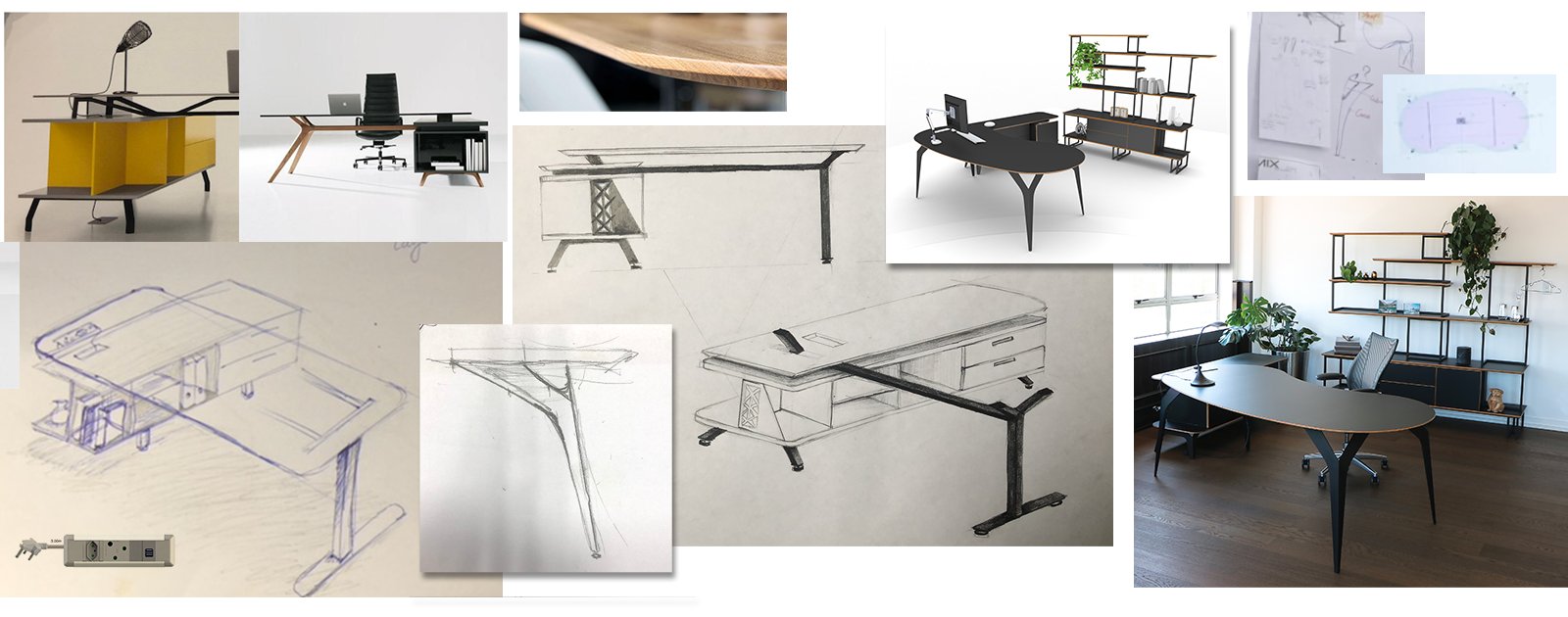
Design Process of Shell Executive range – The aim was to make the user feel in control and empowered.
Form follows function
Proportion is everything! For example, the ratio between a seat and backrest, or the height of a desk-based screen in relation to the desk is where we find balance. If you nail this your design is 9o% complete.
The Materials
Now make it look sexy. Consider the aesthetic you are trying to achieve. Are you aiming for a light-weight, minimalistic product or a centerpiece that doubles as a work of art? What design elements do you want to play with to create tension, symmetry, juxtaposition or harmony? In-office furniture design I try to reduce the design to the simplest form and then play with a unique combination of colour, texture and the inherent qualities (strength, flexibility, softness, fragility) of the materials (wood, steel, glass, fabric) to enhance the aesthetic.
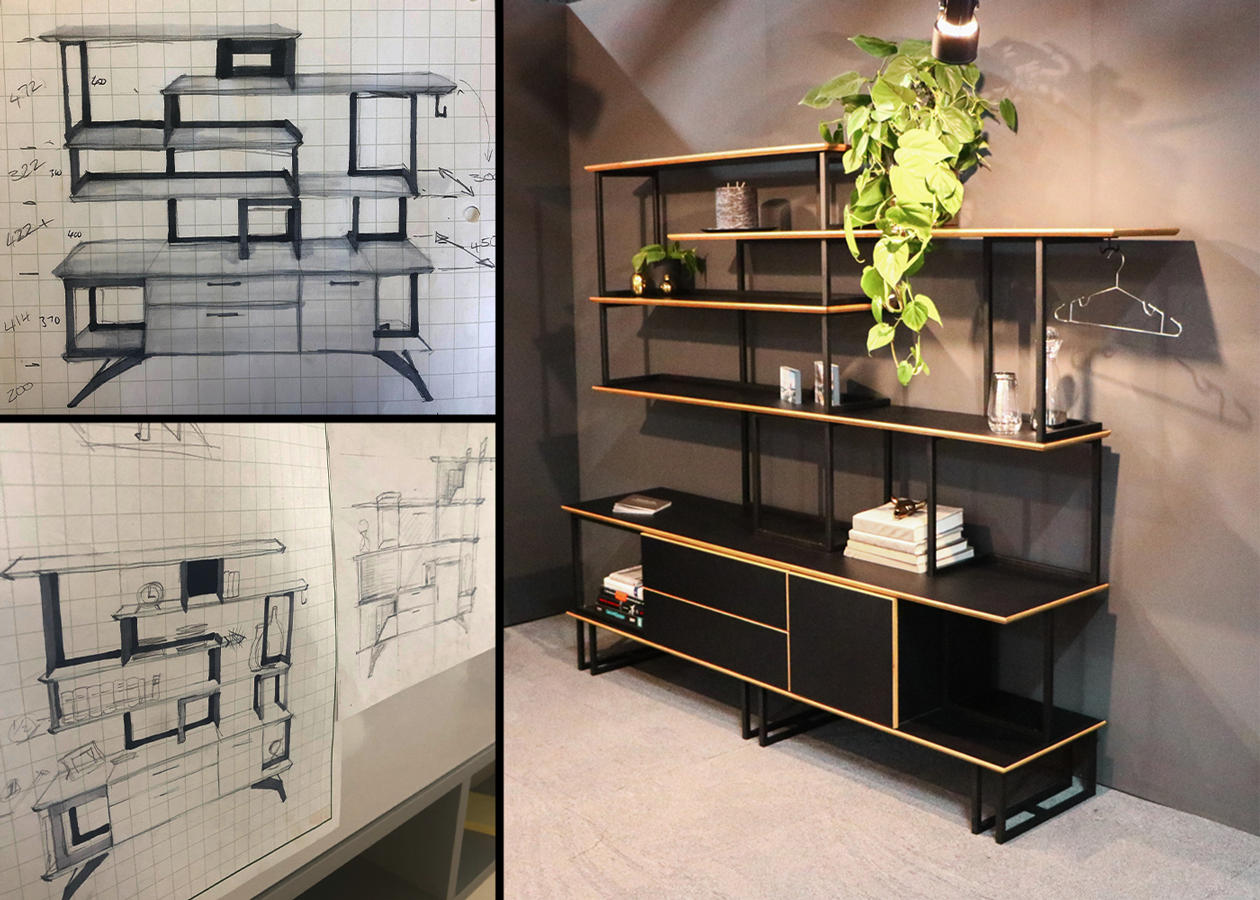
The Range
It is also important to zoom out and consider how different pieces fit and work together. In this case, consistency is a good indicator. Designing a family of products or complementary ranges of products requires an identifiable design element(s) to be present in each individual product. Another trick is to create rules, for example at Entrawood we use 2 prominent heights for office furniture (desk height and counter height) so that when a collection of furniture is viewed as a whole, the eye does not jump around to different heights, but rather travels along the lines.
The Layout
Now lets put into perspective – how this collection of office furniture is laid out in an office space can mean the difference between a happy and thriving team or an irritated and grumpy group of employees. In the opening example, I mentioned that the employee’s desk was facing a wall and located in a high traffic area. What if his/her desk was adjacent to a team member’s, in an area that was designed and equipped specifically for the team. Positioned so that when he/she looked up from his desk he/she could see the anyone approaching, as well as the boardroom where he/she will be presenting later. The view of the outside he/she could see colleagues having a coffee together. He/she would feel a whole lot more in control and relaxed, making him/her more productive. Everyone wins.
Dead space is expensive, my job is to get the most out of every square meter. NOT by squeezing as many desks into it as possible, but rather by creating a layout that caters to the various tasks performed throughout a workday and making it easy to transition from one task to another.
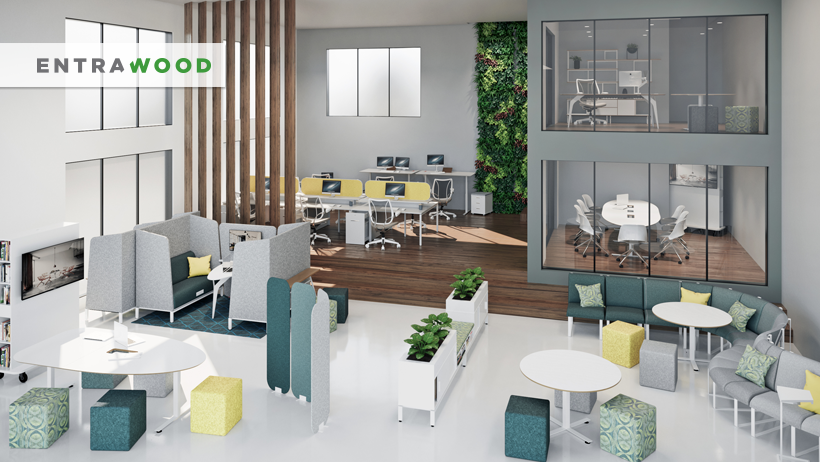
Entrawood Office furniture presented as a family of product – Layout and design by Nushke Klopper, render by Liquid Mesh
